Telescopic Hydraulic Cylinder: How to Calculate Stroke, Stages, and Force at Each Stage
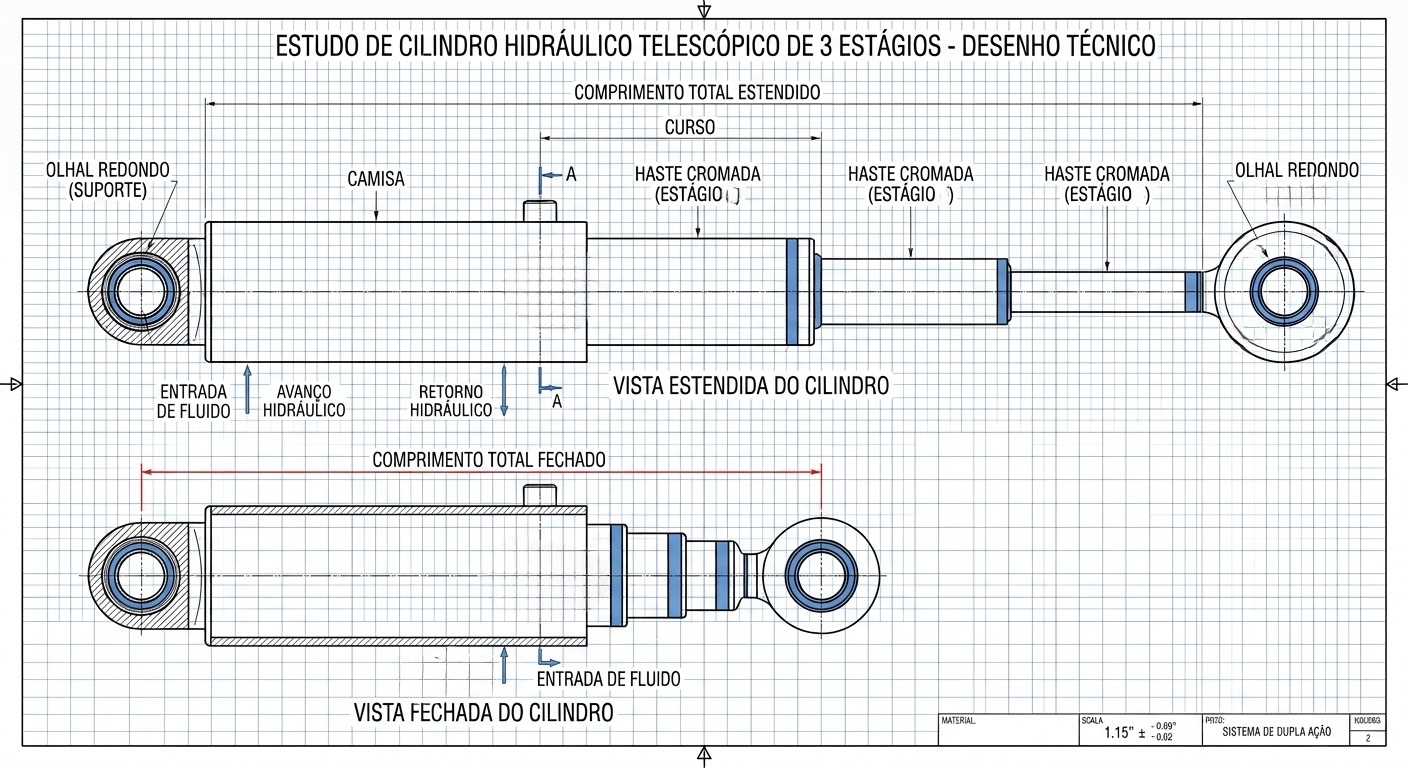
How to calculate total stroke, number of stages, and decreasing force at each stage of a telescopic hydraulic cylinder. Formulas, numerical example, and single vs. double-acting differences.
A telescopic hydraulic cylinder achieves an extended stroke much greater than its closed length because it consists of several concentric tubes (stages) that extend in sequence, from largest diameter to smallest. The total stroke is the sum of the strokes of each stage, and available force decreases with each stage because each tube's working area is smaller than the preceding one. Proper engineering sizing guarantees that even the final stage — with the smallest diameter and lowest force — still supports the required load at maximum extension.
1. How does a multi-stage telescopic cylinder work?
The principle is straightforward: each stage is a tube that slides inside the previous one, like a telescope. Pressurized oil enters the base of the first stage (largest diameter) and pushes it outward. When that stage reaches full stroke, system pressure rises until it overcomes the resistance of the second stage, which then begins to move. The sequence repeats down to the final stage.
This largest-to-smallest extension is the theoretical trend: for the same system pressure, the larger area produces the necessary force with less pressure, so in ideal conditions it moves first. However, in practice, seal friction, guide tolerances, tube alignment, and oil temperature influence the breakaway pressure of each stage. It is common on test benches for an intermediate stage to extend before a larger one. The same applies to retraction. In standard telescopic cylinders without external synchronization valves, this variation is normal and does not indicate a manufacturing defect.
2. How to calculate force at each stage?
The formula is the fundamental hydraulic force equation applied stage by stage for extension force:
- F_n = extension force of stage n
- P = system operating pressure
- D_n = internal bore diameter of the tube housing stage n (effective pressure area)
- A_n = effective cross-sectional area of stage n
Because D_n decreases with each stage and area scales with the square of the diameter (D²), force drops non-linearly. A 20% diameter decrease between stages results in approximately 36% less force (0.8² = 0.64, i.e., 64% of original force). To simulate and verify cylinder force instantly, use our Hydraulic Cylinder Sizing Calculator.
2.1 Retraction force in double-acting telescopic cylinders
On retraction in a double-acting cylinder, pressure acts on the annular ring area (piston area minus rod area):
Thus, retraction force is always lower than extension force at the same pressure, a critical factor when the machine relies on hydraulic power rather than gravity to retract.
2.2 Illustrative calculation example
The following example illustrates the calculation method for a hypothetical 3-stage cylinder at 180 bar (18 MPa):
| Stage | Reference Bore Diameter | Effective Area | Extension Force at Max Pressure |
|---|---|---|---|
| 1 (outer) | 100 mm | 78.5 cm² | ≈ 14.4 tf (141.4 kN) |
| 2 (intermediate) | 80 mm | 50.3 cm² | ≈ 9.2 tf (90.5 kN) |
| 3 (inner) | 60 mm | 28.3 cm² | ≈ 5.2 tf (50.9 kN) |
The critical sizing check is the last stage: if the load at full extension exceeds stage 3's capacity, the cylinder cannot complete the operation, regardless of excess capacity in stages 1 and 2.
3. How to calculate total stroke and closed length?
Total stroke is the sum of the individual strokes of all stages:
Closed length is not simply stroke divided by stages: each stage requires minimum internal overlap with its neighboring tube for lateral support (preventing buckling and guide wear) and high-pressure sealing. More stages allow a shorter closed length for the same total stroke, but increase sealing complexity, cost, and reduce final-stage force.
4. How many stages to specify?
INCOCIL commonly engineers telescopic cylinders from 2 to 5 stages. Choosing the stage count is a trade-off among three variables:
- Required closed length (installation envelope available when retracted).
- Total stroke required (extended reach).
- Minimum acceptable force at the final stage.
5. Force sizing vs. Euler buckling verification
Calculating force ensures sufficient power, but does not guarantee the extended slender tube will resist buckling under compressive load. As stages extend, unsupported length increases, creating peak buckling vulnerability at full stroke.
The baseline formula is Euler's critical buckling load:
- E = modulus of elasticity of steel (~200 to 210 GPa)
- I = moment of inertia of the hollow tube section: I = π × (D_ext⁴ − D_int⁴) / 64
- L = unsupported free length at maximum extension
- K = column effective length factor (depends on end mountings: clevis, flange, or trunnion)
Crucial engineering takeaway: force scales with D², but buckling resistance scales with D⁴. When unsupported length is large, increasing stage diameter yields exponentially greater buckling margin than force gain.
6. Single-acting vs. Double-acting telescopic cylinders
| Criterion | Single-acting | Double-acting |
|---|---|---|
| Extension | Hydraulic pressure | Hydraulic pressure |
| Retraction | Gravity, load weight, or spring | Hydraulic pressure in reverse chamber |
| Hydraulic lines | Single line | Dual lines (extension & retraction) |
| Retraction speed control | Limited (depends on load and flow valves) | Fully controlled via return flow rate |
| Typical applications | Dump truck beds, vertical lifts, tipping platforms | Horizontal booms, motorhome leveling, master-slave systems |
| Complexity & cost | Lower | Higher (internal dual-chamber porting and seals) |
Rule of thumb: if the equipment operates vertically or inclined with sufficient gravity to retract, single-acting is the most reliable, cost-effective choice. If operating horizontally or requiring precise retraction speed, double-acting is required.
7. Common applications
Dump trucks, hydraulic cargo elevators, mobile aerial platforms, and agricultural telescopic booms are prime examples where maximum stroke in compact envelopes is essential.
8. Frequently Asked Questions (FAQ)
Do stages always extend in order from largest to smallest?
Theoretically yes, but seal friction and mechanical tolerances can cause an intermediate stage to move first. This is normal in standard units.
Does force decrease linearly across stages?
No. Force decreases with the square of the diameter (D²), resulting in steeper drops between stages.
Can all stages have double-acting capability?
Yes, via internal fluid channels in each stage, though it increases sealing complexity and manufacturing cost.
Can a cylinder with plenty of force still buckle?
Yes. Force and buckling resistance are independent engineering checks. Both must be validated stage by stage.
INCOCIL® has manufactured 2 to 5 stage telescopic hydraulic cylinders for over 45 years under the PATROL® brand in Porto Alegre, Brazil. For units in service, we also provide specialized cylinder maintenance and overhaul services.
Marcus Roberto Jung
Mechanical Engineer and Director at INCOCIL, Brazilian hydraulic cylinder manufacturer with 45+ years of market presence. Directing custom engineering projects for agricultural, transportation, industrial, forestry, and mining sectors.
Need custom cylinders or engineering sizing?
Use our online calculator to simulate force and sizing parameters, or contact our engineering team for custom industrial and agricultural projects.
Related Articles
Explore more technical guides and updates from INCOCIL
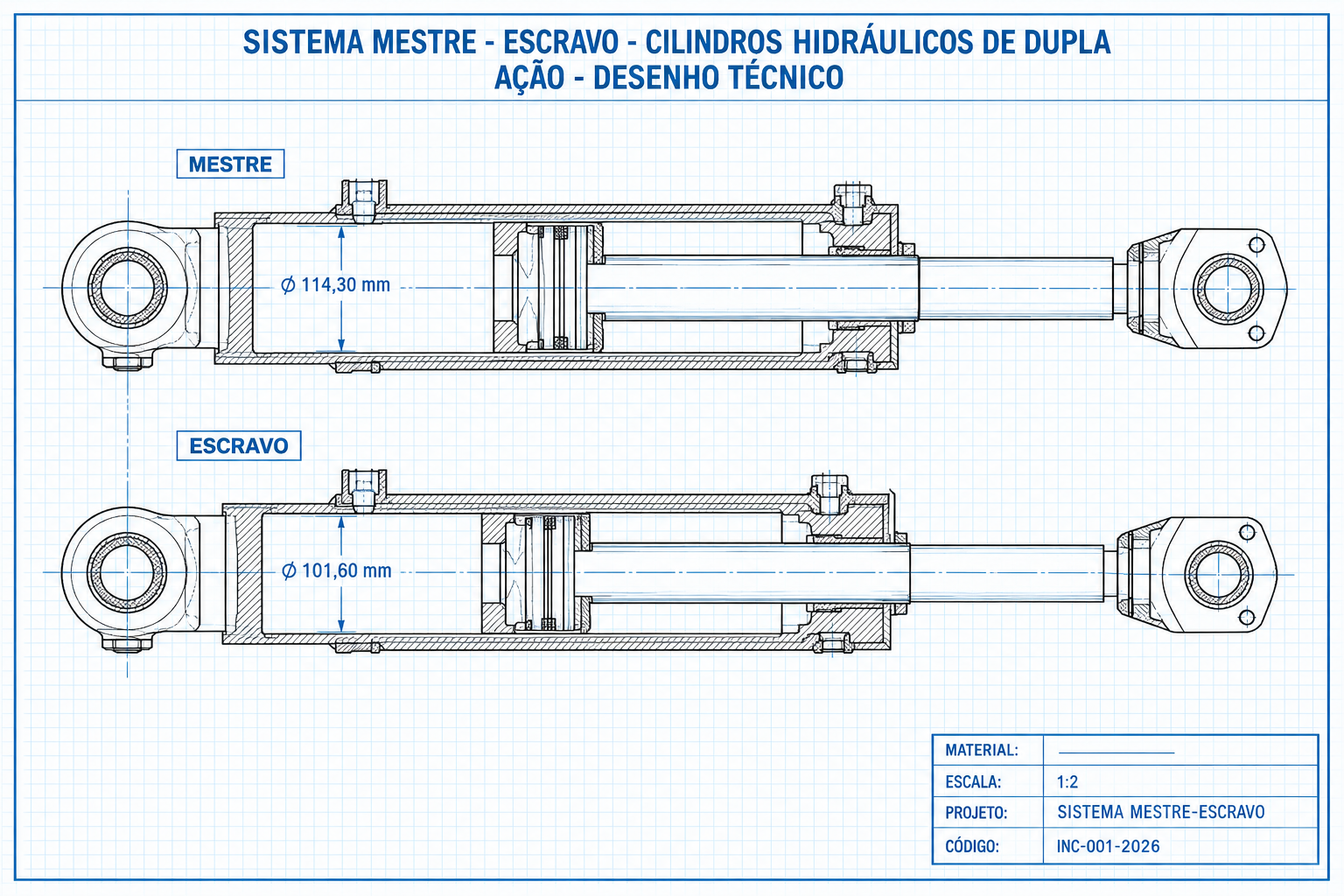
Master-Slave Hydraulic Cylinder: How Does Sensorless Hydraulic Synchronization Work?
Understand how master-slave hydraulic cylinders synchronize multiple actuators without sensors, how to calculate master and slave displacement areas, and how this solution compares to flow dividers and electronic servo synchronization.
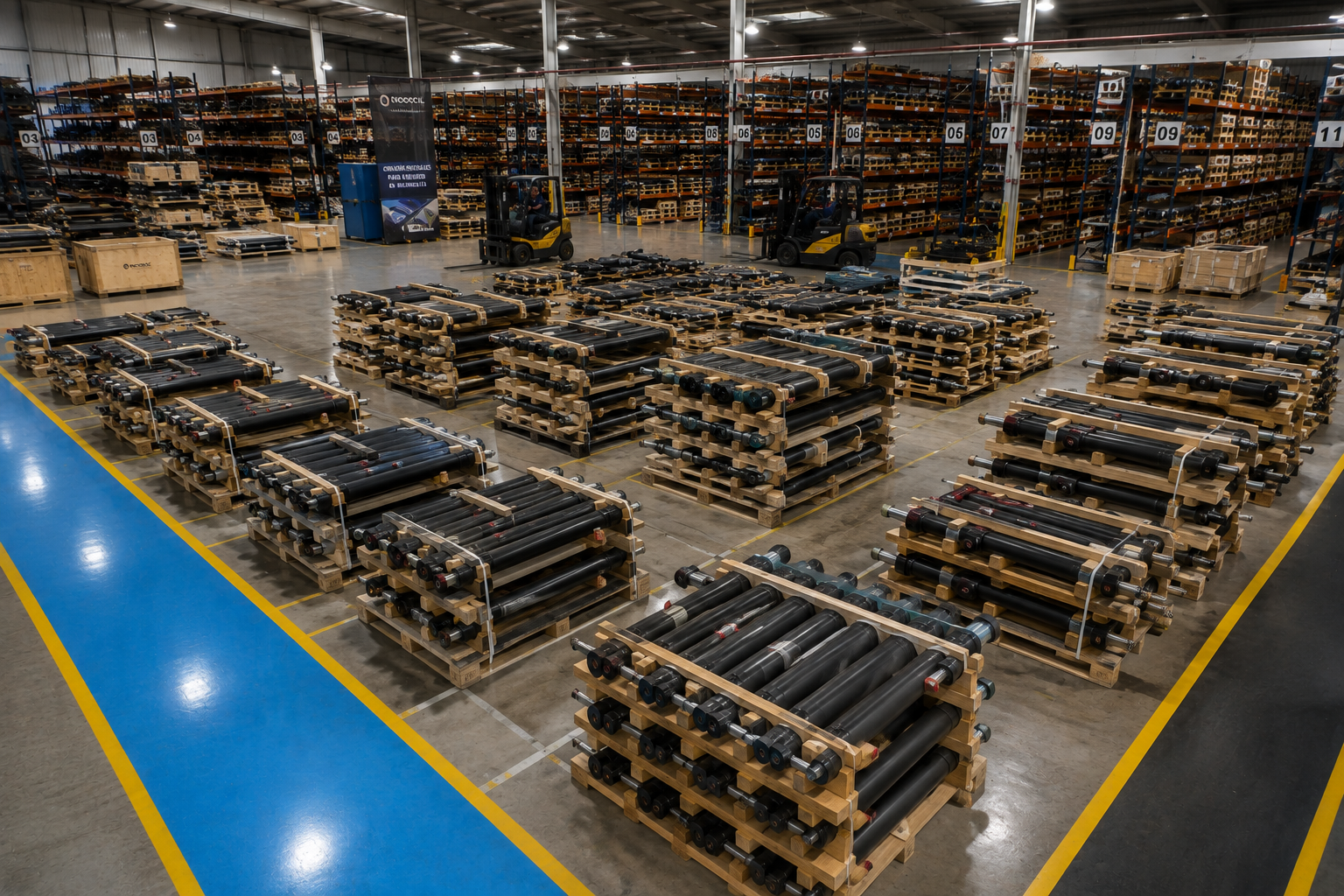
Equipment idle for months? What you need to know before reactivating your cylinders
Has your hydraulic equipment been idle in the yard for six months or more? Stored cylinders can suffer slow seal degradation and internal corrosion. Learn how to store and what to check before restarting.
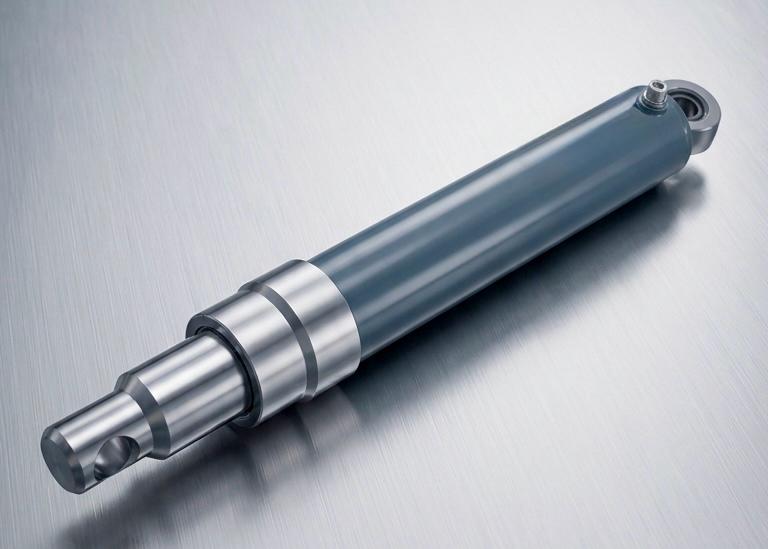
Single-Acting Hydraulic Cylinders: Types, Advantages, and How to Choose
A complete guide to single-acting hydraulic cylinders: learn the three types (Oil-over-Air, Buzo, and Ram), the advantages of each construction, and how to choose the right model for your application.